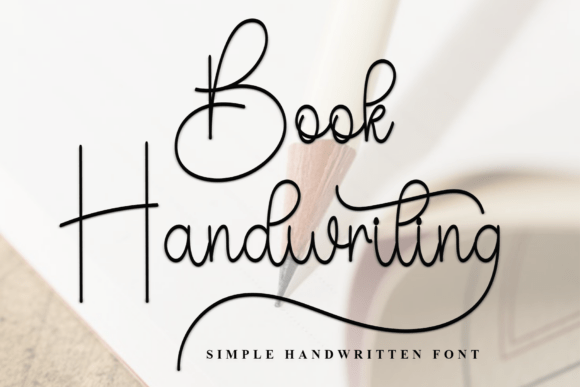
Book Handwriting: A Warm Script Font for Creative Makers
There’s a certain magic that happens when you’re sitting at your craft desk, pulling up a new font for a candle label design. The screen glows, you type a single word—maybe “Vanilla” or “Home”—and suddenly the whole mood shifts. That’s exactly how it felt the first time I loaded Book Handwriting. The letters didn’t just sit on the page; they seemed to lean in, all soft curves and gentle, rounded strokes. I knew instantly this was a script font that would pour warmth into everything from product packaging to a simple gift tag.
As a maker, the fonts I choose never just fill space. They carry the personality of the item, they whisper to a customer before they even read the words, and they anchor the entire handmade aesthetic. Book Handwriting became a quiet favorite the moment I tested it on a candle label mockup. Its playful, hand-drawn charm translated so naturally onto the frosted glass surface, making the product feel like a cozy gift rather than a store-bought purchase. That’s the kind of creative font storyteller every small shop owner needs.
First Impressions on a Candle Label
Picture a simple amber jar candle. The wax is a milky white, the scent a mellow chai spice. On my screen, I placed the fragrance name in Book Handwriting right at the center of a kraft-paper label. The typeface’s round, casual strokes hugged each letter like a handwritten note from a friend. It wasn’t formal calligraphy with rigid flourishes, nor was it a messy scrawl. It landed in that sweet spot: approachable, legible, and completely human.
What struck me most was how the font’s slightly bouncy baseline gave the label a relaxed, artisan feel without sacrificing clarity. Even on a small, circular label roughly two inches wide, the name sat beautifully. I adjusted the tracking a little and let the loops of the ‘h’ and the ‘g’ breathe. In a world of sleek, minimalist labels, this script amp style felt like a warm handshake.
Where Book Handwriting Feels Most at Home
A font like this doesn’t demand center stage; it gracefully fills the spaces where personal connection matters. Think about the products handmade sellers pour their hearts into. Book Handwriting naturally slips into those moments. I’ve found it particularly effective on:
- Greeting cards and invitations: The lettering on a birthday invitation or a baby shower card becomes a gentle voice. A short phrase like “You’re Invited” in this handwritten font feels like a personal note, not a printed form.
- Product packaging and tags: Boutique clothing tags, hang tags for crochet items, or folded thank-you notes tucked inside an order. The font’s friendly personality elevates the unboxing experience without feeling over-designed.
- Printable wall art and planner pages: A digital download featuring a morning mantra or a kitchen quote prints with a warm, homemade vibe. Because the strokes are clean but not sterile, the text remains readable at a moderate size on a 5x7 print.
- Mugs, shirts, and tote bags: When applied to a ceramic mug or a canvas tote, the font’s roundness softens the whole design. A simple “Stay Cozy” on a sweater or “Market Fresh” on a reusable bag gains an honest, unpretentious voice.
Practical Charm for Seasonal and Everyday Products
Last fall, I designed a set of pumpkin farm-style signs for a local market booth. The wooden boards needed lettering that felt hand-painted but crisp enough to read from a few feet away. Book Handwriting carried the farmhouse feel perfectly. The words “Fresh Apples” and “Cider Here” looked like they’d been painted by a steady, cheerful hand. The display drew people in, and the font’s character made each sign feel crafted rather than mass-produced.
Around the holidays, I turned to the same font for gift tag stickers. Using a Cricut machine, I cut white vinyl with names in Book Handwriting. Because the letterforms aren’t excessively thin, weeding was a breeze. The adhesive tags stuck smoothly onto kraft paper gift bags, and the recipients often asked if I had written them myself. That illusion of a personal touch—on a sticker, no less—is exactly what a display font with this much warmth can achieve.
From Wedding Welcome Boards to Boutique Labels
A friend who runs a small wedding paper business recently borrowed the idea. She set a welcome sign in Book Handwriting for a rustic garden reception. The lettering, paired with a simple sans serif for the details, created a harmonious look. The bride’s and groom’s names sat front and center, looking both elegant and relaxed. It was a reminder that this modern typography choice can bridge the gap between casual and celebratory.
For product makers, consistency is key. When a customer sees the same friendly lettering across a product label, an Etsy listing thumbnail, and an Instagram story, recognition builds. Book Handwriting on a soap wrapper, then on a product card, then on a thank-you sticker, stitches a quiet brand identity together. It says, “We pay attention to the little things.”
Readability and Real-World Production Tips
A big question I ask with every font is: how does it behave in the real world, under a cutting blade or on textured paper? Book Handwriting holds up well for medium to larger display text. The rounded strokes mean that even with a slightly fibrous cardstock, the printing comes through clearly. For small-scale applications—say, a tiny ingredient list on a lip balm tube—I’d recommend using it for the product name only, then pairing it with a clean sans serif font for the fine print.
If you’re designing for a cutting machine, do a test cut first. The script’s connected letters are gently joined, so at very small sizes (less than half an inch tall), you may need to adjust the line spacing or separate letters manually. For stickers and labels intended for two- or three-inch circles, the native flow works without any hitches. I often run a quick weeding test on a scrap piece of vinyl: if the tiny loops of the ‘e’ or ‘o’ weed cleanly, I know I’m at a safe size.
Pairing Book Handwriting with Other Typefaces
No font exists in a vacuum, and the real design magic happens when you pair them. Book Handwriting thrives alongside a no-fuss sans serif like Open Sans, Montserrat, or Lato. The contrast between the script’s warm, organic curves and the sans serif’s clean geometry gives a layout breathing room. For a wedding invitation suite, I’ve paired it with a delicate serif font—something like Playfair Display or Cormorant—for a romantic yet grounded editorial feel. The key is to let the script amp style carry the headline or the focal name, then use the secondary font for supporting details like dates, addresses, or care instructions.
If you want to lean fully into the handcrafted look, try pairing it with a simple, all-caps handwritten font for subtle accent labels. Just be careful not to combine two competing scripts. Let Book Handwriting be the star voice, and keep the supporting cast minimal.
Working Inside the Script Amp Category
As part of the Script Amp font collection, Book Handwriting brings the energy of hand-drawn lettering with the polish of a professional typeface. The “amp” in script amp often hints at a personality that’s turned up just a notch—more bounce, more warmth, more character. That’s exactly what you get here. It’s not a fragile, looping calligraphy script; it’s a robust, everyday commercial font that can handle repeated use on physical merchandise without losing its charm.
Before diving into production, I always confirm the font files and licensing. Book Handwriting typically comes with standard OTF and TTF files, and many versions include alternates or ligatures that add even more variety. Those little extras can make a single product name look slightly different each time you use it—perfect for limited edition batches or seasonal branding updates. Always check the commercial font license terms if you plan to sell items featuring the font: most allow physical product sales, but if you’re creating digital templates or SVG designs for others to use, you’ll want to ensure you have the appropriate extended license. Multilingual character support is another blessing; I’ve used it for simple French and Spanish phrases on bilingual product labels with no missing characters.
Bringing Your Shop’s Story to the Surface
Every time I prepare a new batch of mugs, tote bags, or thank-you stickers, I think about the person on the other end. They might not notice the font name, but they will feel the cozy, unforced friendliness that comes with it. Book Handwriting has a way of melting away that overly corporate edge and replacing it with something genuine. For a small shop founder, that’s priceless. It helps turn a simple item into a keepsake, a product into a memorable unboxing experience.
Whether you’re printing card inserts for a custom order, setting up a mockup for a new digital download listing, or weeding a fresh sheet of vinyl tags, this creative font stands ready. It doesn’t pretend to be anything other than what it is: a friendly, rounded, utterly approachable script that makes your handmade work feel like home. And in a busy marketplace, that feeling is the quiet advantage that keeps customers coming back.